
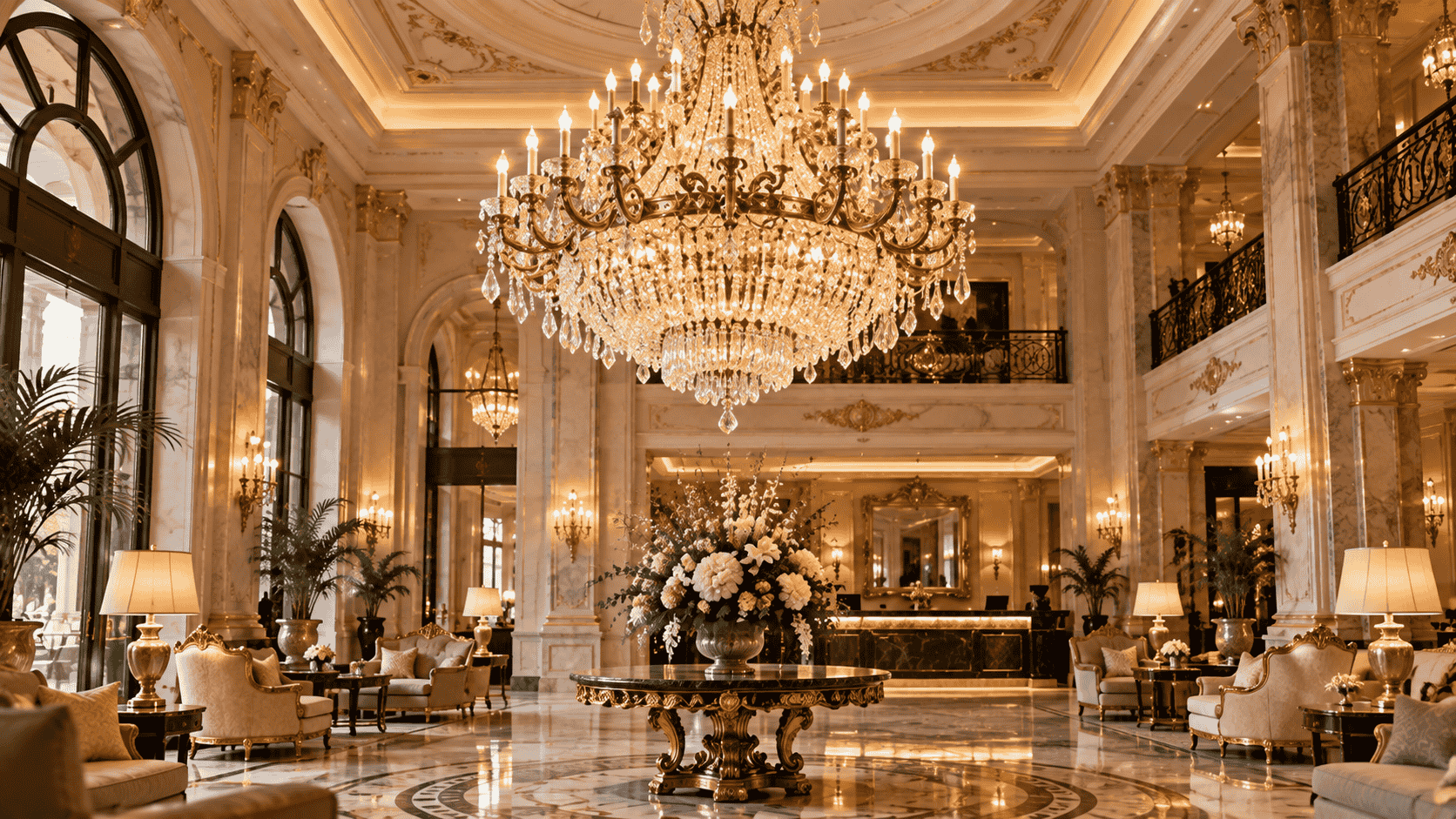
The doors open and the first thing a guest notices is not the reception desk or the seating. It is the light. Suspended high above the polished floor, an oversized baroque crystal chandelier catches every available ray and returns it as a soft cascade of sparkle. In that single upward glance the lobby stops feeling like a public space and begins to feel like the entrance hall of a private palace.
This is the quiet power of a well-chosen hotel lobby chandelier. When the scale, crystal quality and placement are resolved correctly, one fixture can redefine the entire arrival experience. European luxury and boutique hotels have long understood this effect. A single statement piece often delivers more atmosphere than a dozen smaller fittings.
The Instant Visual Promise of Scale
Palace architecture relied on volume and vertical drama. An oversized baroque crystal chandelier borrows the same language. Its multi-tier form fills the upper air of the lobby, drawing the eye upward and making even a moderately high ceiling feel more generous.
Proportion is critical. Designers commonly aim for a fixture height that relates to the overall ceiling height—roughly one-eighth to one-twelfth of the vertical space—so the chandelier occupies the volume without crowding it. Diameter is judged against the floor area it anchors, often the central seating zone or the axis leading to reception. When these relationships are correct, the piece feels inevitable rather than imposed.
The result is immediate. Guests sense grandeur before they have taken ten steps. The lobby reads as intentional, composed and quietly ceremonial.
Placement That Creates a Stage
Location determines how the chandelier performs. Centring the fixture above a primary focal zone—reception desk, central seating cluster or the main circulation path—turns that area into a stage. Light falls evenly across faces and surfaces while the surrounding volume remains softer.
Clearance remains non-negotiable. The lowest point of the chandelier should sit high enough to preserve sightlines and allow free movement, typically at least 2.4 metres above finished floor level in circulation areas. In double-height atriums the fixture can drop more generously, provided it never interrupts the view or the flow of guests and luggage.
Symmetry with architectural features strengthens the effect. Aligning the chandelier with a dome, a coffered ceiling panel or the centreline of a grand staircase reinforces the sense of order that palace interiors once projected.
How Crystal Turns Light into Atmosphere
Crystal is not merely decorative. Its cut surfaces fracture and redirect light, creating depth and movement that flat fixtures cannot match. In a baroque chandelier the combination of arms, tiers and cascading drops produces layered illumination: brighter at the core, softer and more sparkling at the edges.
Warm colour temperature—typically in the 2700K to 3000K range—enhances the effect. It recalls candlelight and firelight, associations that feel intimate even in a large public room. When the fixture is dimmed for evening, the sparkle remains while the overall intensity softens, shifting the lobby from daytime clarity to evening ceremony.
Natural light interacts with the same crystals during the day. Sunlight entering through high windows or skylights produces shifting highlights that keep the fixture alive even when the electric lamps are off. The result is a piece that changes character with the hours yet never loses presence.
Engineering the Palace Effect Without Excess
An oversized baroque crystal chandelier succeeds when it feels substantial rather than heavy-handed. Material quality matters. High-clarity crystal with precise cutting maximises refraction and minimises the dullness that cheaper glass can introduce at large scale. Metalwork—whether gold-toned, antique brass or polished chrome—should feel continuous with the rest of the lobby’s finishes.
Structural considerations are equally important. The ceiling must be assessed for load, anchoring points and access for future maintenance. Dimming circuits, emergency lighting integration and coordination with other ceiling services are resolved at the design stage so the finished installation looks effortless.
When these technical layers are handled well, the chandelier reads as architecture rather than applied decoration. Guests experience the atmosphere; they do not notice the engineering behind it.
Supporting Elements That Complete the Illusion
The chandelier does not work in isolation. Surrounding hotel lobby furniture, floor finishes and secondary lighting either support or undermine the palace atmosphere. Soft seating arranged beneath or near the fixture invites guests to linger in the illuminated zone. Reflective surfaces—polished stone, mirrored accents or high-gloss timber—multiply the sparkle without competing for attention.
Perimeter lighting is often kept deliberately quieter so the central fixture retains hierarchy. Wall sconces or discreet downlights provide functional illumination while the chandelier supplies the emotional tone. The combination creates zones of intimacy within a larger volume, another technique borrowed from historic palace planning.
Practical Considerations for Hotel Owners
Specifying such a piece requires early decisions. Lead times for custom or large-scale baroque chandeliers can be significant. Sample crystals and metal finishes should be reviewed under the same lighting conditions planned for the lobby. Mock-ups or digital visualisations help confirm scale before fabrication begins.
Maintenance access must be planned from the outset. A fixture that is beautiful but difficult to clean will gradually lose its impact. Dust accumulation dulls crystal; a practical cleaning regime preserves the sparkle that makes the investment worthwhile.
Finally, the chandelier should align with the property’s overall positioning. In a heritage palace hotel the ornate language feels continuous. In a more contemporary luxury setting a refined interpretation of baroque form—cleaner arms, controlled crystal density—can still deliver the same sense of occasion without visual conflict.
The Lasting Impression
A single oversized baroque crystal chandelier does more than light a room. It sets the emotional temperature of arrival. Guests who look up and see cascading light and precise craftsmanship carry that impression into the rest of their stay. The lobby feels less like a transit space and more like the threshold of a private world.
When scale, placement and light quality are resolved with care, the effect is both immediate and enduring. The hotel communicates heritage, attention and quiet confidence in one upward glance. That is the enduring lesson European luxury properties continue to apply: sometimes the most powerful statement is the one that hangs overhead and simply shines.
Frequently Asked Questions
How large should a hotel lobby chandelier be relative to the space?
A common guideline is a fixture height of roughly one-eighth to one-twelfth of the ceiling height, with diameter sized to the zone it anchors. Exact proportions depend on the specific volume and viewing distances.
What is the minimum clearance under a large chandelier?
In circulation areas, maintain at least 2.4 metres from the lowest point of the fixture to the finished floor to preserve sightlines and movement.
Does crystal quality make a noticeable difference at large scale?
Yes. High-clarity, precisely cut crystal maximises sparkle and light distribution. Lower-grade glass can appear dull or inconsistent when viewed from distance in a large lobby.
Can one oversized chandelier replace multiple smaller fittings?
In many lobbies a single well-scaled central fixture creates stronger hierarchy and atmosphere than several smaller ones, provided secondary lighting still supports functional needs.
You may also read
10 Creative Ways to Use Large Outdoor Planters Around Luxury Hotels
Would You Keep a Cloudy Antique Mirror in a Five-Star Suite?
Schreibe einen Kommentar