
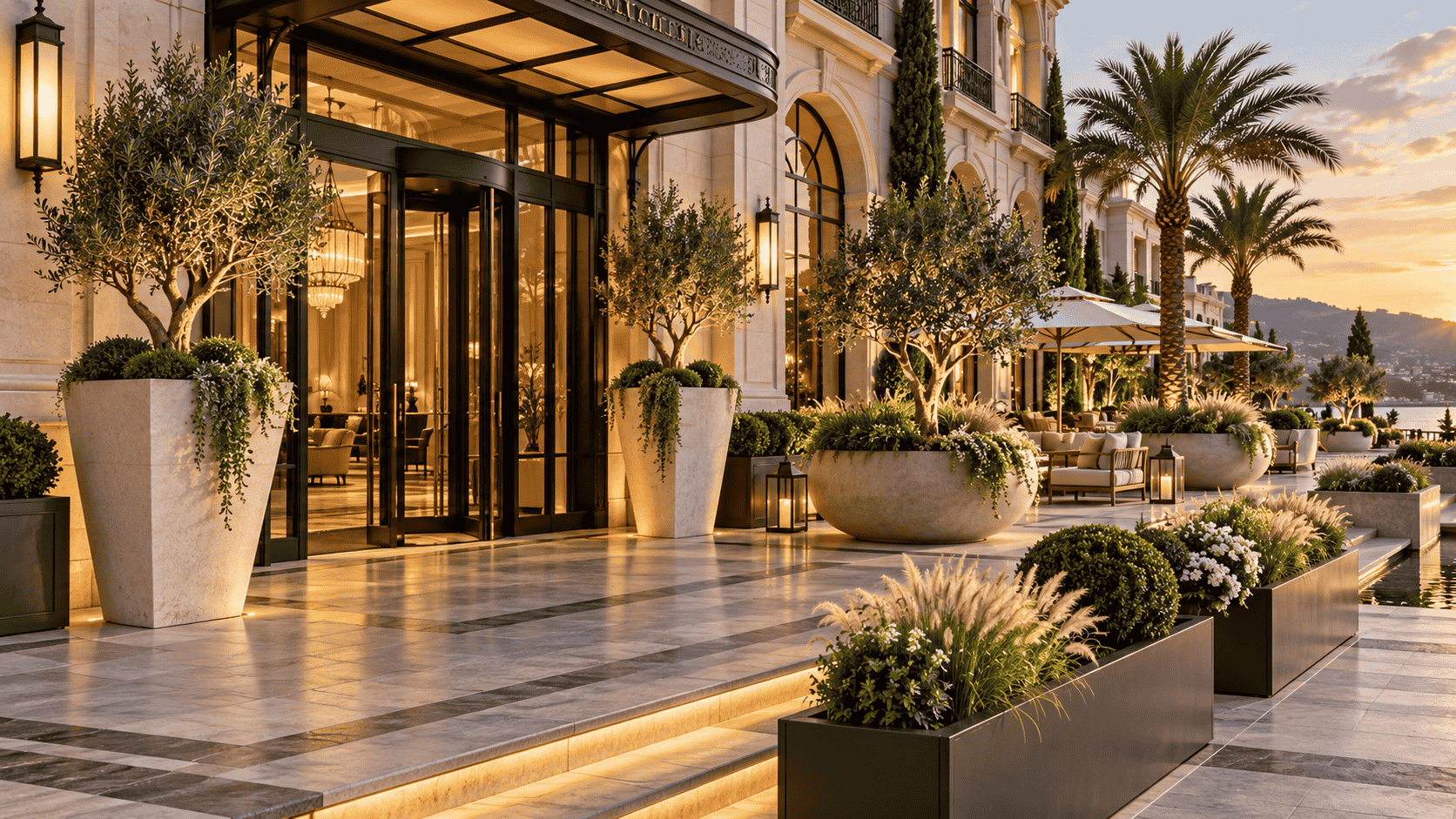
Luxury hotel landscaping begins long before a guest reaches the reception desk.
The entrance driveway, terrace, pool deck, restaurant patio and outdoor lounge all contribute to the first impression of a property. Thoughtfully positioned large outdoor planters can help these areas feel more structured, welcoming and visually connected without requiring major permanent landscaping.
For hotel owners and designers, planters also offer flexibility. They can define circulation, introduce privacy, frame architectural features and bring greenery to paved areas where traditional planting beds may not be practical.
Real hospitality projects show how important this can be. At the InterContinental Hotel on Park Lane in London, bespoke exterior planters were incorporated into the frontage and entrance landscaping, while large planters at Hilton Canary Wharf were specifically scaled to suit the surrounding architecture.
The key is placement.
Here are 10 creative ways hotels can use decorative planters, large outdoor planters and large planters to create more polished exterior spaces.
1. Frame the Main Hotel Entrance
The hotel entrance is one of the strongest locations for oversized planting.
A pair of matching large outdoor planters positioned on either side of the main doorway instantly creates symmetry and directs attention toward the entrance.
For classical hotels, urn-shaped or rounded decorative planters can complement ornate façades. Modern properties may benefit from tall rectangular or tapered forms with restrained finishes.
Planting should match the architecture as well. Clipped evergreens provide formality, while small olive trees, palms or sculptural shrubs can create a more relaxed resort atmosphere.
Hospitality landscape guidance frequently uses symmetrical planter placement to strengthen arrival areas and soften large architectural surfaces.
The result is simple but powerful: guests immediately understand where the arrival experience begins.
2. Turn the Porte-Cochère Into a Grand Arrival Zone
The drop-off area often contains large areas of paving, columns and vehicle circulation.
Without landscaping, it can feel functional rather than luxurious.
Strategically positioned large planters can change that impression.
Use monumental rectangular or square planters around columns, along the edge of the drop-off zone or near the transition between vehicles and pedestrian areas.
A recent luxury hotel case study used four monumental planters around a porte-cochère, each designed to hold mature specimen planting and reinforce the arrival experience. The project also had to account for drainage, structural loading and wind stability.
That last point matters. When large outdoor planters contain mature trees, their engineering requirements should be considered as seriously as their appearance.
3. Use Planters to Guide Guests Toward Reception
Outdoor landscaping can act as subtle wayfinding.
Instead of relying entirely on signs, arrange decorative planters along pedestrian routes leading from parking areas, drop-off points or courtyards toward the main lobby.
Repeating the same planter style creates a visual rhythm.
For example, a sequence of tall planters containing ornamental grasses can lead guests toward an entrance without creating a physical barrier.
Hospitality planting specialists note that planters positioned around walkways and arrival zones can help guide guests naturally toward reception areas.
This approach works especially well in resorts where buildings are spread across a larger property.
4. Create Elegant Privacy Around Outdoor Dining
Hotel restaurants often need outdoor dining areas to feel open and private at the same time.
Large outdoor planters provide one of the easiest ways to achieve that balance.
Long rectangular planters filled with dense greenery can create soft boundaries around restaurant terraces without introducing solid walls.
Plants such as ornamental grasses, evergreen shrubs, bamboo varieties suitable for containers, or other climate-appropriate foliage can screen tables while still allowing light and airflow.
Unlike permanent partitions, large planters can also be repositioned as seating layouts change.
This flexibility is especially valuable for hotels that regularly host private events, weddings or seasonal dining concepts.
5. Divide Large Terraces Into Smaller Lounge Zones
A very large hotel terrace can sometimes feel empty even when it contains premium furniture.
The problem is often scale.
Use groups of decorative planters to divide the terrace into smaller zones for conversation, dining or relaxation.
For example, place three large planters between two lounge settings rather than using a hard divider.
The greenery creates a visual boundary while keeping the overall terrace connected.
Hospitality environments also require close attention to planter finish and durability because guests spend longer periods beside them than they would in a typical public landscape.
For this reason, premium hotels should consider the planter itself as part of the furniture composition rather than as a background accessory.
6. Add Resort Character Around the Pool
Pool decks often contain expansive areas of stone, tile or timber.
Adding large outdoor planters can soften these hard surfaces and introduce the lush atmosphere associated with luxury resorts.
Position oversized pots near loungers, cabanas or pool entrances rather than crowding the water’s edge.
Palms, architectural grasses and tropical foliage can create a strong resort aesthetic where the local climate allows.
For Mediterranean-style properties, olive trees, citrus or drought-tolerant planting can produce a completely different character.
The goal is continuity.
Using a coordinated family of decorative planters around the pool, terrace and pathways can create a consistent visual language across the property.
Hotel and resort landscape suppliers often describe this coordinated approach as a way of carrying a continuous green identity from entrances through leisure areas.
7. Create a Statement Around Outdoor Sculptures
Luxury hotels frequently feature sculptures, fountains or artworks in courtyards and entrance gardens.
Large planters can help frame these features rather than compete with them.
Position two or three restrained planters around an artwork to create visual balance.
Avoid using overly elaborate planting if the sculpture itself is already complex.
Simple clipped greenery or architectural foliage often works better because it creates contrast.
This technique is particularly effective where permanent planting beds cannot be added around existing paving.
The artwork remains the hero, while the planters help connect it with the wider landscape.
8. Upgrade Long Hotel Façades
Long hotel façades can feel repetitive, especially where the ground level contains continuous glazing or stone cladding.
A sequence of large outdoor planters can break this repetition.
Place them at regular intervals between windows, architectural bays or entrances.
At Hilton Canary Wharf, bespoke planters reaching approximately two metres in height were designed specifically to relate to the scale of the building frontage.
That demonstrates an important design principle: the larger the architecture, the more visual presence the planter may require.
Small pots can disappear beside a multi-storey façade.
Properly proportioned large planters become part of the architecture.
9. Refresh Courtyards With Seasonal Displays
Hotel courtyards are ideal locations for flexible seasonal planting.
Rather than permanently redesigning landscaping several times a year, hotels can use decorative planters as changeable display points.
Spring flowers, summer foliage, autumn planting and winter arrangements can all be introduced using the same containers.
This keeps the hotel’s outdoor areas visually fresh for returning guests.
The Savoy in London provides a useful hospitality example. Its planting scheme has included entrance planters, palms and seasonal bedding selected to complement the hotel’s Art Deco character.
For luxury hotels, seasonal planting should still feel controlled.
Repeat a small number of colours and plant varieties rather than mixing too many unrelated styles.
10. Turn Empty Corners Into Photo-Worthy Moments
Some of the most shareable areas in hotels are not necessarily the largest.
An overlooked courtyard corner, terrace landing or blank wall can become a striking guest-photo location with the right combination of large outdoor planters, seating and lighting.
Try grouping planters at different heights.
A tall planter containing an architectural tree can form the background, while lower decorative planters introduce layered greenery closer to the seating.
Add a sculptural chair, bench or subtle wall lighting and the corner can become a memorable visual moment.
This is particularly valuable for boutique hotels and resorts where social-media imagery contributes to how guests perceive the property.
The important point is restraint. The space should look designed rather than staged.
How to Choose Large Outdoor Planters for a Hotel
Placement is only half the decision.
The planter itself should suit the property’s architecture, local climate and operational requirements.
Material matters. Hotels should consider resistance to weather, UV exposure, impact and moisture. Drainage is equally important, especially where planters sit on finished stone or tiled surfaces.
Maintenance teams should also be involved before specification.
Ask how the planter will be moved, watered, cleaned and replanted.
For very large installations, consider soil weight, mature plant weight, drainage connections and wind exposure. These factors can become significant when specimen trees are installed in oversized containers.
Finally, think about proportion.
A luxury planter should relate to the scale of the building, furniture and planting around it.
Final Thoughts
Large outdoor planters can do far more than hold plants.
Used strategically, they can frame entrances, guide guests, divide terraces, create privacy, soften façades and turn unused exterior areas into memorable hospitality spaces.
The strongest results come when decorative planters are treated as part of the architectural design rather than added at the end of the project.
Choose forms that complement the building. Scale them appropriately. Select planting suitable for the local conditions and maintenance schedule.
Most importantly, use large planters to support the guest journey.
When landscaping, architecture and hospitality design work together, even a simple planter can help make an outdoor hotel space feel considerably more refined.
Schreibe einen Kommentar