
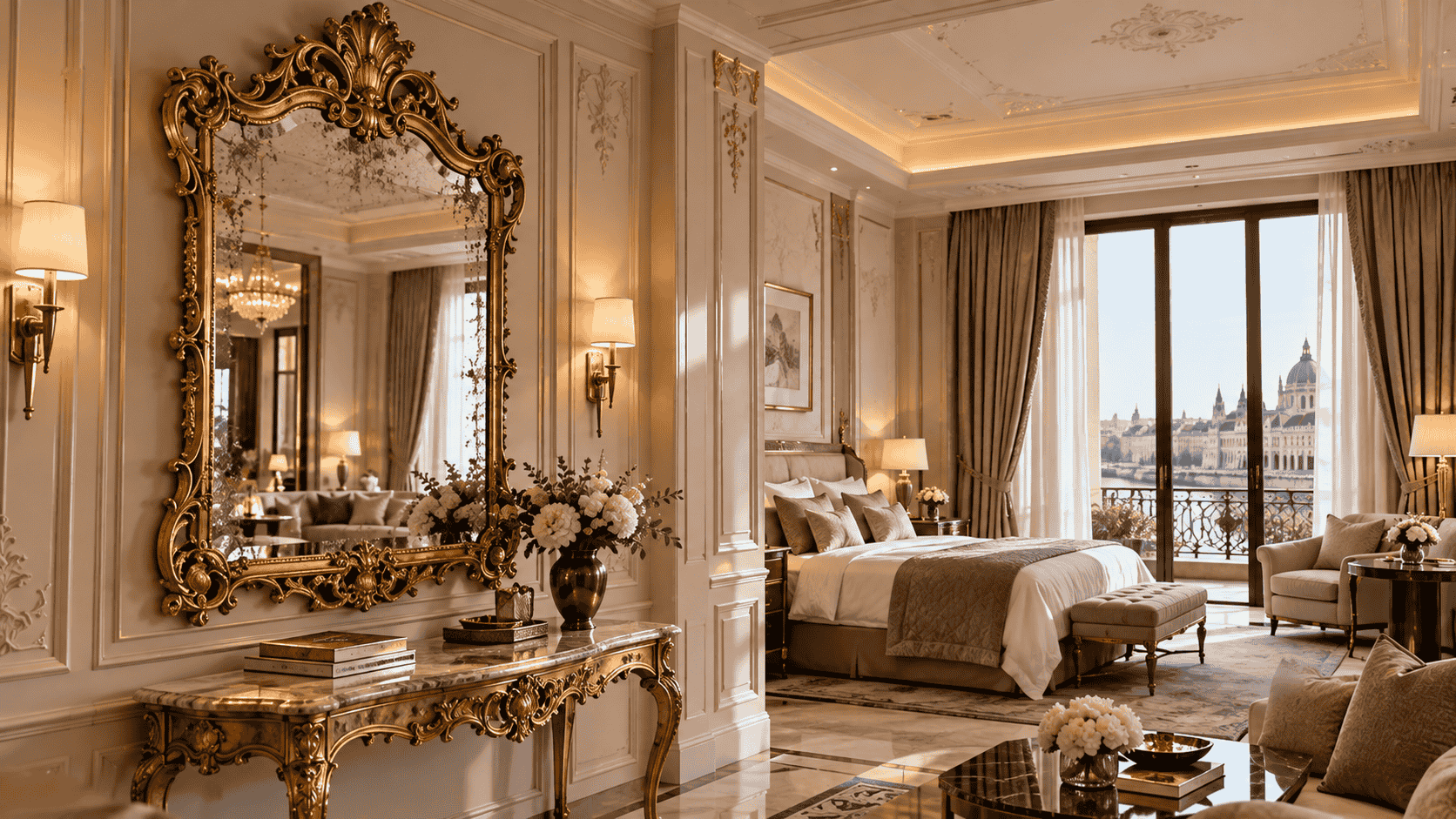
A five-star suite promises clarity in every detail. Guests expect sharp reflections for grooming, accurate colour under carefully planned lighting, and surfaces that feel maintained rather than weathered. Yet many European heritage properties and design-led boutique hotels still face a recurring question: should an original cloudy antique mirror stay in place, or should it be replaced or restored for reliable performance?
The debate is real. On one side stands historic character—the soft foxing, subtle waviness and aged silvering that give an antique baroque mirror its distinctive presence. On the other stands practical guest experience. A mirror that fails to deliver a clear reflection undermines the sense of polished luxury that defines a five-star stay.
This article examines both positions, outlines the technical realities of antique mirror glass, and offers a structured way for hotel owners and designers to decide.
The Case for Keeping the Cloudy Character
Original antique mirrors carry a quality that new glass cannot fully replicate. Hand-blown or early plate glass often shows gentle irregularities. The silvering develops foxing—dark or cloudy patches caused by moisture and oxidation over decades. For many designers working in heritage hotel design, these marks are not defects. They are evidence of age and authenticity.
In a carefully composed suite, a slightly imperfect reflection can soften the room and reinforce a sense of continuity with the building’s past. Baroque mirrors with ornate frames especially benefit from this layered history. The glass becomes part of the narrative rather than a purely functional surface.
Some guests respond positively to this atmosphere. They notice the difference between a mass-produced clear panel and a piece that feels collected. In signature suites or public areas where the mirror is primarily decorative, the cloudy effect can add depth without serious practical compromise.
The Practical Arguments Against Cloudiness
Hotel bathrooms and dressing areas place different demands on a mirror. Guests use them for detailed tasks: applying make-up, shaving, checking clothing. A cloudy or uneven reflection makes these tasks harder and can leave a subtle impression of neglect.
Desilvering—the breakdown of the reflective backing—spreads over time, especially in humid environments. Once moisture reaches the silver layer, dark spots expand. Cleaning the front surface does nothing to reverse the damage. In high-occupancy rooms the problem accelerates.
Modern luxury standards also favour accurate colour rendering. Low-iron glass and consistent silvering produce neutral reflections that show skin tones and room finishes correctly. An aged antique mirror glass often introduces a greenish or grey cast that alters the intended lighting design.
For these reasons many operators treat functional clarity as non-negotiable in primary guest-use locations.
Understanding What Causes the Cloudiness
Cloudiness in antique mirrors usually stems from one of three sources. The most common is deterioration of the silver or mercury backing. Moisture seeps under the edges or through micro-cracks and oxidises the metal layer. The result is black spots, haze or large opaque areas.
Surface deposits and old cleaning residues can create a temporary film, but these are usually removable with careful conservation methods. More serious is glass disease or inherent instability in older formulations, which can produce permanent misting.
Distinguishing between reversible surface issues and irreversible backing failure is the first technical step in any decision.
Options for Hotel Mirror Restoration
When an original piece is worth keeping, professional hotel mirror restoration offers several paths. Resilvering removes the degraded backing and applies a new reflective layer. On genuinely historic glass this preserves the original plate, including its characteristic waves and thickness variations.
The process is specialised and not always perfect. Older glass may have surface imperfections that affect the final clarity. Costs are higher than simple replacement, and results depend heavily on the condition of the original plate.
An alternative is to retain the ornate frame and replace the glass with new antique-style mirror glass. Modern manufacturers produce controlled foxing, veining or aged finishes that mimic historic appearance while delivering consistent reflection and meeting current safety standards. This approach is often more practical for multi-room projects where uniformity and durability matter.
Frame restoration can proceed independently. Gilding, carved details and structural integrity can be conserved even if the glass itself is renewed.
A Structured Way to Decide
Before approving any course of action, owners and designers should examine the specific mirror in context. Ask whether the piece is primarily decorative or actively used for grooming. Evaluate the extent of cloudiness and whether it is still progressing. Consider humidity levels in the room and the availability of specialist restorers.
Compare the visual contribution of the original glass against the operational risk of guest dissatisfaction. In a signature suite the character may justify careful conservation. In a high-turnover standard room the balance usually tips toward reliable clarity.
Sample boards that show both original cloudy glass and new antiqued alternatives help stakeholders see the difference under project lighting. Involving the housekeeping and guest-experience teams in the review often surfaces practical concerns that pure design discussion can miss.
Finding the Right Balance for Five-Star Standards
The strongest outcomes rarely choose one extreme. Many successful European hotels keep genuine antique baroque mirrors in low-moisture, primarily decorative locations while specifying clear or controlled-antique glass in bathrooms and dressing areas. Frames remain consistent across the property, preserving visual continuity.
Where original glass is retained, protective measures—sealed edges, controlled humidity and gentle cleaning protocols—slow further deterioration. Where new glass is introduced, the specification can still reference historic finishes so the overall atmosphere stays coherent.
The decision ultimately rests on the property’s positioning. A palace hotel with strong heritage credentials may accept more visual ageing. A contemporary five-star brand focused on precision and comfort will prioritise reflection quality. Both approaches can succeed when the choice is deliberate rather than accidental.
Making the Call with Confidence
Cloudy antique mirrors sit at the intersection of character and performance. They offer irreplaceable atmosphere in the right setting and create friction in the wrong one. By separating decorative value from functional requirement, testing options under real lighting conditions, and understanding the technical limits of restoration, hotel teams can reach a decision that serves both the design story and the guest experience.
The question is not whether history belongs in a five-star suite. It is whether the particular form of history carried by a cloudy reflection still serves the standards the hotel has set for itself.
Frequently Asked Questions
Can cloudy antique mirror glass be fully restored to modern clarity?
Resilvering can improve reflection significantly, but older glass often retains some surface irregularities. Complete modern clarity usually requires new glass.
Is it better to replace the glass or keep the original in a hotel bathroom?
In high-humidity bathrooms most operators prefer new or controlled-antique glass for durability and consistent performance. Original glass is more suitable in drier, decorative locations.
Do new antique-style mirrors look convincing next to genuine pieces?
High-quality modern antique mirror glass can match the visual language closely when specified carefully, especially when frames and lighting are consistent.
How quickly does desilvering progress in a hotel environment?
Progress depends on moisture exposure and edge sealing. In humid bathrooms untreated deterioration can become noticeable within a few years of heavy use.
Schreibe einen Kommentar