
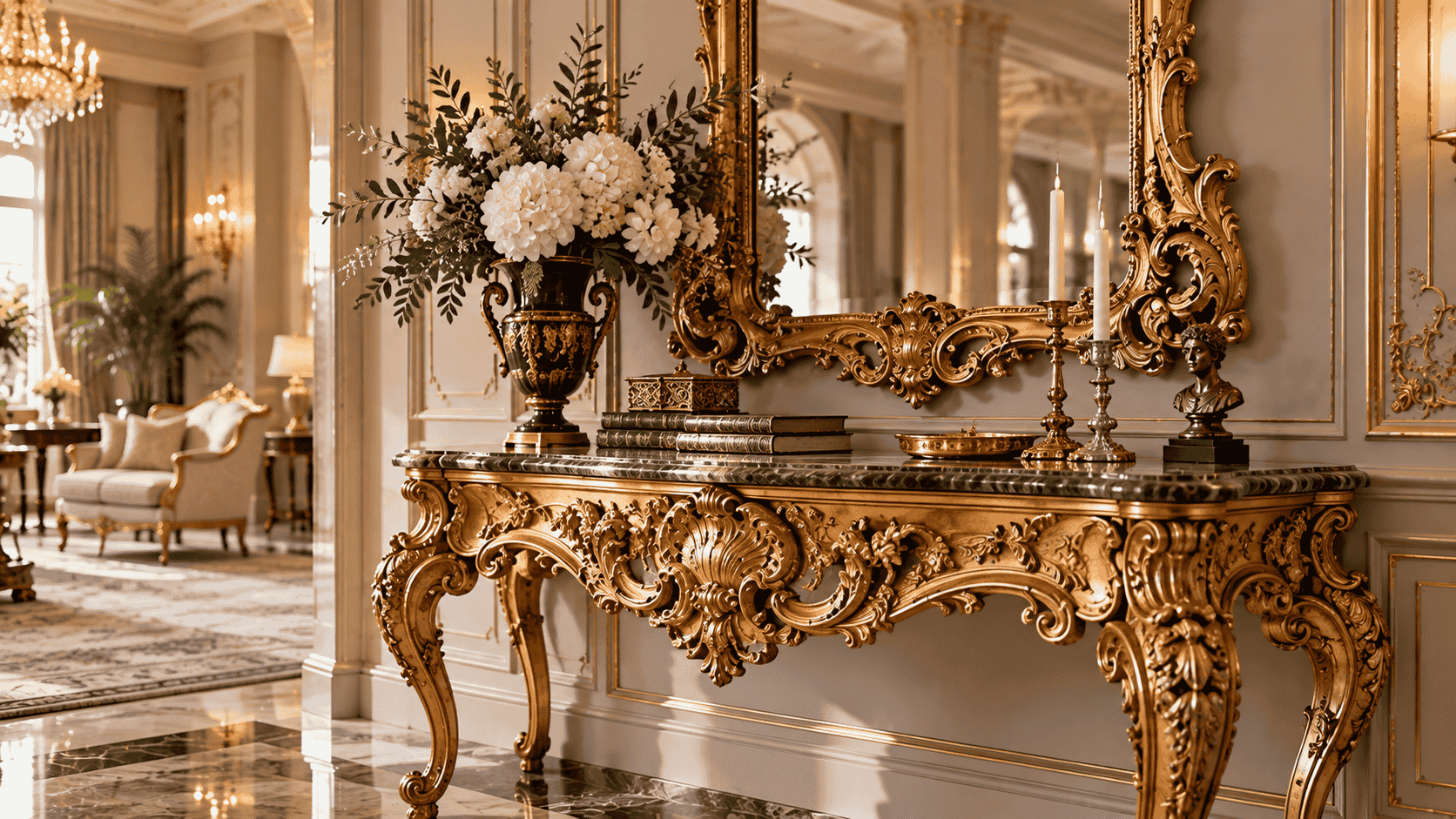
Commissioning a bespoke baroque console is rarely a casual decision. For luxury hotels the piece often anchors a lobby, corridor or suite entrance. It must carry visual weight, survive daily use and still feel like a genuine expression of craft rather than a catalogue item. The difference between a successful commission and an expensive disappointment usually lies in the questions asked before the first chisel touches wood.
This article draws on conversations with European makers who specialise in handcrafted baroque furniture. Their answers reveal what actually determines whether a custom hotel console table justifies its cost and lead time.
Why Proportions Come Before Ornament
Experienced carvers begin with the room, not the decoration. A console that looks balanced in a workshop can overwhelm a narrow corridor or disappear against a high ceiling. Makers therefore ask for exact wall lengths, ceiling heights, adjacent door swings and the intended viewing distance.
The height of the top surface, the projection from the wall and the visual weight of the apron all interact. In hotel settings the console must also leave enough clear floor space for housekeeping and guest movement. Getting these measurements right early prevents later compromises that dilute the baroque character.
One maker put it simply: “If the proportions are wrong, no amount of carving will save the piece. Guests feel the imbalance even if they cannot name it.”
The Reality of Hand Carving
True baroque ornament is three-dimensional. Leaves, shells and volutes need undercutting so that light and shadow give the surface depth. Machine-routed decoration rarely achieves the same liveliness. Hand carving allows the artisan to adjust depth and flow according to the grain and the specific design.
Lime wood remains a preferred choice for fine detail because of its even texture and resistance to splitting. Beech and other hardwoods are used where greater structural strength is required. The best workshops combine both: a stable structural core with carved elements in the most workable timber.
The process is slow. Complex aprons and legs can require weeks of concentrated work. Hotels that understand this timeline avoid the frustration of treating a bespoke baroque console like a standard furniture order.
Materials That Survive Hotel Life
A console in a public area faces luggage, cleaning chemicals and constant handling. Makers therefore specify finishes and constructions that go beyond domestic standards. Kiln-dried timber with controlled moisture content reduces the risk of movement after installation. Joinery is mechanical and long-grain rather than relying solely on adhesives.
Marble or stone tops are sealed against etching and staining. Gilding, whether traditional water gilding or more durable modern equivalents, is applied in layers that can accept light cleaning without immediate loss of surface. The goal is a piece that retains its presence after years of service rather than one that looks perfect only on delivery day.
The Importance of Samples and Approvals
Serious makers insist on physical samples before full production. These usually include timber samples with the proposed finish, a section of carving to show depth and style, and a sample of any metal leaf or paintwork. For larger projects a full-scale mock-up of a leg or apron section may be produced.
These samples allow the hotel’s design team to judge colour under the actual lighting of the space and to confirm that the carving language matches the rest of the interior. Changes at the sample stage are far less costly than alterations once the full piece is underway.
Buyers should treat sample approval as a formal gate. Written confirmation of dimensions, materials and finish protects both parties and reduces later disagreement.
Questions Every Buyer Should Ask the Maker
The following questions consistently surface in successful commissions. They can be reused almost verbatim.
What timber species will form the structural frame and what species will be used for the carved elements?
How is the piece engineered to remain stable in a climate-controlled but high-traffic hotel environment?
Can you provide a carved sample that shows the actual depth and undercutting proposed for this design?
What is the expected lead time from final approval of samples to delivery, and how are delays communicated?
How is the finish protected against commercial cleaning products, and what maintenance protocol do you recommend?
If a leg or carved section is damaged in five years, can the workshop supply a matching replacement part?
Clear answers to these points separate workshops that understand hospitality requirements from those that primarily serve private residential clients.
Future Repairs and Longevity
One of the strongest arguments for commissioning rather than buying ready-made is the possibility of future repair. A well-documented bespoke piece can often be restored or partially remade by the original workshop. Photographs, material specifications and carving templates held on file make matching far easier than attempting to repair an anonymous catalogue item years later.
Hotels that keep these records treat the console as a long-term asset rather than a disposable finish. The initial investment is amortised over a longer service life, and the piece continues to support the property’s design identity.
When the Commission Is Worth It
A bespoke baroque console justifies its cost when three conditions are met. The design responds precisely to the architecture and circulation of the space. The craftsmanship delivers depth and material quality that standard production cannot match. The maker provides transparent process, samples and a realistic path for future care.
When those elements align, the console stops being merely furniture. It becomes a fixed point of character in the hotel—something guests notice, designers remember and operators can maintain with confidence.
The decision to commission is therefore less about nostalgia for historical style and more about control: control over proportion, over material performance and over the long-term presence of the piece within the building. For hotels that value that level of precision, the conversation with the right maker remains one of the most productive steps in the entire design process.
Frequently Asked Questions
How long does a typical bespoke baroque console commission take?
From final sample approval to delivery, most specialised workshops require between three and six months, depending on complexity and current order books.
Is hand carving always necessary for a baroque look?
Machine processes can approximate the style, but genuine depth, undercutting and variation in the carving still require skilled hand work for the highest level of presence.
Can dimensions be adjusted for narrow hotel corridors?
Yes. Depth reduction and careful management of projection are common requests. The maker should confirm that the revised proportions still support the intended visual weight.
What records should the hotel keep after delivery?
Material specifications, finish codes, dimensional drawings and high-resolution photographs of the carving details. These make future repairs or matching far more reliable.
You may also read
Would You Keep a Cloudy Antique Mirror in a Five-Star Suite?
Schreibe einen Kommentar