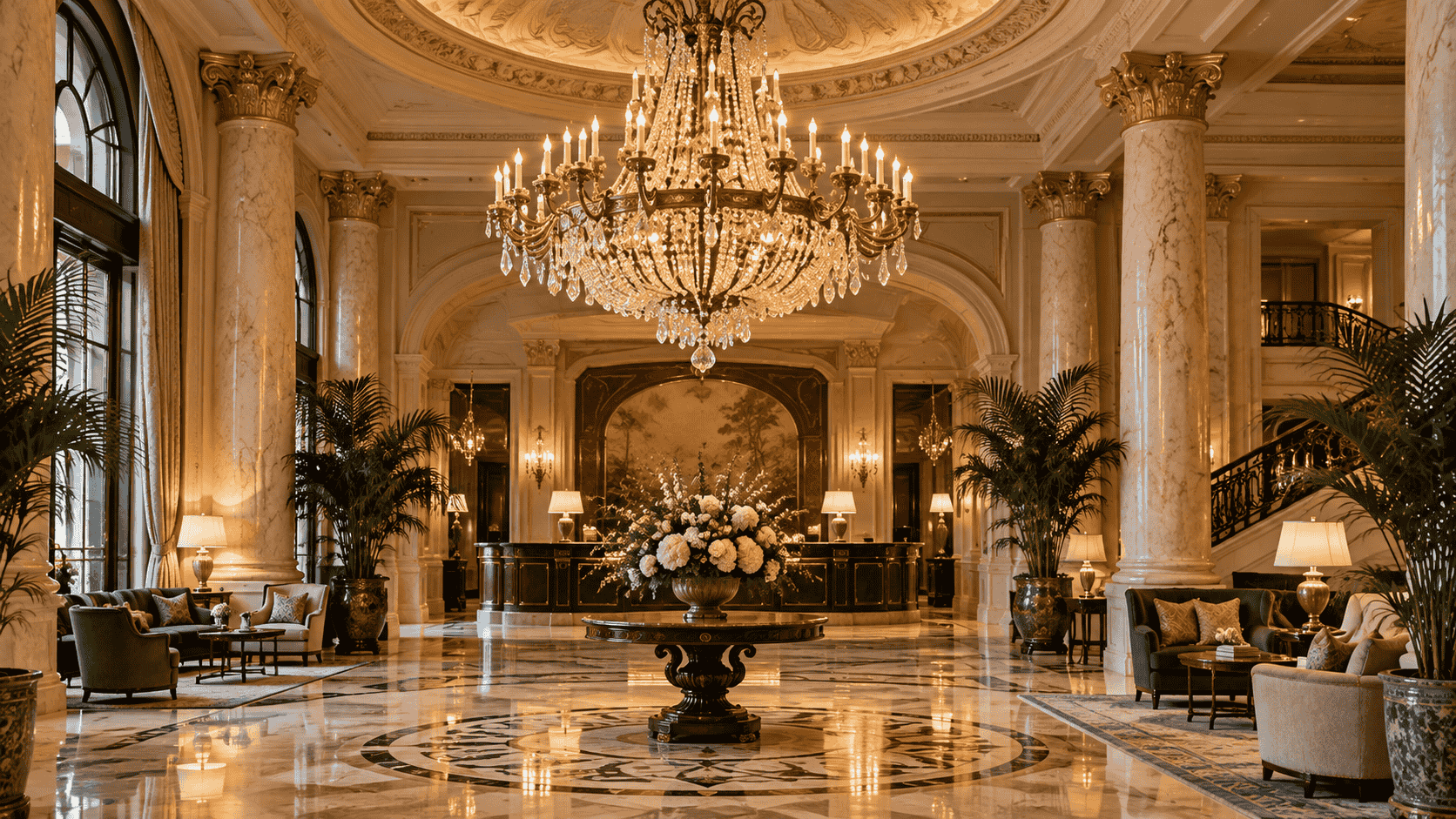
A hotel lobby has only a few seconds to establish its character.
Before guests reach reception, notice the furniture, or speak with staff, they have already formed an impression from the proportions, materials, lighting and atmosphere around them.
That is why the chandelier positioned above a hotel entrance, reception hall or lobby lounge can carry far more visual responsibility than an ordinary ceiling light.
The right luxury hotel chandelier establishes scale, creates a focal point and helps turn an otherwise functional arrival space into something memorable. When the architecture calls for heritage character, antique chandeliers can add another valuable quality: a sense of history and permanence that is difficult to reproduce with purely functional lighting.
But simply installing a large decorative fixture does not automatically make a lobby luxurious.
Scale, ceiling height, materials, detailing, lighting temperature and its relationship with the architecture all matter.
Here is how hotel owners and designers can choose antique lobby lighting that genuinely elevates the guest experience.
Why Does a Chandelier Influence the Perceived Value of a Hotel Lobby?
Luxury interiors are often judged as a complete visual composition rather than as a collection of individual expensive objects.
A chandelier immediately draws attention upward. This makes guests more aware of ceiling height, architectural volume and decorative detailing.
In hotel design, large-scale decorative lighting is frequently used specifically to strengthen the sense of arrival. For example, Hirsch Bedner Associates described creating a dramatic welcome at Shangri-La at the Fort through large-scale lighting and fixtures, with a custom chandelier acting as a central lobby feature.
That principle is important.
A luxury hotel chandelier does more than illuminate furniture below it. It can visually organise an entire reception area.
Positioned correctly, it can tell guests:
This is the main arrival space.
This is where the architecture reaches its highest point.
This is the visual centre of the lobby.
That hierarchy helps a hotel feel intentionally designed.
Antique Chandeliers Add Something New Lighting Often Cannot
There is a difference between something that looks expensive and something that feels established.
Well-chosen antique chandeliers introduce patina, craftsmanship, historic references and material depth.
Examples from the antique market demonstrate how varied this vocabulary can be. Historic hotel and European chandeliers include combinations such as brass with hand-blown glass, bronze with rock crystal, and ornate brass structures with hanging crystal prisms.
These materials react strongly to ambient light.
Crystal refracts it.
Aged brass softens it.
Bronze adds visual weight.
Hand-worked glass creates irregular reflections that can make the fixture feel less manufactured and more individual.
For a boutique hotel, heritage property or classical luxury resort, those qualities can make antique lobby lighting feel like part of the property’s identity rather than simply another decorative purchase.
Scale Is the First Test of a Luxury Hotel Chandelier
One of the most common mistakes is choosing a chandelier that is impressive on its own but too small for the architecture surrounding it.
Hotel lobbies frequently contain double-height spaces, broad staircases, oversized reception desks and substantial furniture. A residential-scale chandelier can disappear visually within those proportions.
General chandelier-sizing guidance recommends starting with room dimensions and then considering fixture shape, hanging height and visual weight. Kichler, for example, recommends using room dimensions as an initial reference when determining chandelier diameter.
However, commercial lobby spaces need additional judgement.
An ornate chandelier can appear visually larger than a minimalist fixture with identical dimensions because of its decorative density. Visual Comfort specifically notes that fixture design affects perceived scale, meaning diameter alone should not be treated as an absolute sizing rule.
For hotel projects, mock up the approximate chandelier volume before ordering.
Even a temporary outline suspended at the proposed height can reveal whether the fixture has enough presence.
Ceiling Height Matters Just as Much as Diameter
A beautiful chandelier installed at the wrong height can interrupt circulation or lose its relationship with the lobby.
The chandelier should sit low enough to feel connected to the interior but high enough to preserve visual openness and guest movement.
In areas where people walk directly underneath, clearance is essential. General lighting guidance recommends maintaining adequate head clearance beneath chandeliers installed over circulation areas.
Very tall hotel lobbies create another challenge.
Hanging the fixture too close to the ceiling can make it appear detached from the furniture and reception zone below.
A long chandelier, multi-tier design or substantial suspension chain can help fill that vertical space.
There are genuine historical examples of monumental chandeliers exceeding four metres in height, illustrating how dramatically scale can change when decorative lighting is designed for grand architectural volumes.
The goal is proportion—not size for its own sake.
Choose a Style That Supports the Hotel Story
The best luxury hotel chandelier should look as though it belongs to the building.
For a Baroque-inspired property, crystal droplets, gilded detailing, scrolling arms and ornate bronze structures can reinforce the architecture.
A Belle Époque or Parisian-style hotel might suit bronze and crystal.
An Art Deco lobby could benefit from geometric glass, tiered forms and warm metals.
A country estate hotel may call for something less polished, with aged brass, iron or traditional candle-style detailing.
For contemporary luxury hotels, contrast can also work beautifully.
A carefully selected antique chandelier above a restrained marble reception desk can create tension between old and new.
That contrast often feels more sophisticated than reproducing one historic style across every surface.
Materials Strongly Affect the Luxury Impression
Not all decorative finishes communicate the same mood.
Crystal
Crystal immediately introduces sparkle and ceremonial character.
It works particularly well in grand receptions, palace hotels and formal lobby lounges.
Historical hotel lighting provides plenty of precedent. Chandeliers associated with properties such as New York’s Plaza Hotel have featured crystal combined with bronze or brass.
Brass
Brass provides warmth without necessarily feeling excessively formal.
Polished brass creates stronger glamour, while aged or patinated brass works particularly well for antique lobby lighting.
Bronze
Bronze feels heavier and architecturally grounded.
It works beautifully in classical, French, Italian and Baroque-inspired interiors.
Hand-Blown Glass
Hand-blown or textured glass can soften the theatrical appearance of a large fixture.
Historic hotel chandeliers combining brass structures with hand-blown glass demonstrate how the material can work at substantial scale without relying entirely on crystal decoration.
Luxury Requires More Than Decorative Light
One chandelier should rarely be responsible for the entire lobby lighting scheme.
Guests need to identify reception, circulation routes, seating areas and architectural features comfortably.
Modern hospitality lighting strategies therefore combine decorative fixtures with ambient, accent and task lighting.
Signify’s guidance for reception spaces recommends using lighting to define pathways, highlight focal points and support intuitive navigation, while adjustable brightness and colour temperature can help adapt the atmosphere throughout the day.
Think of antique chandeliers as the visual signature.
Then allow concealed architectural lighting, wall lights, floor lamps and reception lighting to handle supporting roles.
Warmth Is Critical to Antique Lobby Lighting
A chandelier filled with excessively cool white lamps can undermine the very warmth its antique materials are supposed to provide.
Brass, bronze, crystal and gilded finishes generally become richer under warmer light.
For a hotel lobby, the aim should be welcoming illumination rather than clinical brightness.
The exact specification should still depend on surrounding finishes and the project’s broader lighting scheme.
Dimming is particularly valuable.
Morning arrivals, busy afternoon check-ins and evening cocktail hours do not necessarily require identical lighting conditions.
Modern controls can allow the decorative fixture to remain visually consistent while its intensity changes throughout the day.
Three Lobby Scenarios: Which Chandelier Works?
The Grand European Hotel
Picture a double-height lobby with marble flooring, moulded ceilings and a sweeping staircase.
A small contemporary pendant would probably feel underpowered.
A large tiered crystal and bronze chandelier gives the room the visual weight required by the architecture.
The Boutique Heritage Hotel
Imagine timber panelling, restored floors, antique furniture and a smaller reception hall.
Here, an enormous ballroom chandelier may overwhelm the room.
A more restrained aged-brass antique chandelier can provide historical character without dominating every element around it.
The Contemporary Five-Star Lobby
Now picture large stone surfaces, minimal furniture and clean architectural lines.
A highly decorative antique chandelier can become the intentional contradiction.
Instead of competing with ornament elsewhere, it becomes the principal decorative object.
This can transform the luxury hotel chandelier into functional artwork.
Hotel Chandelier Selection Checklist
Before approving a fixture, review a few practical factors:
- Is the chandelier proportionate to the lobby width and ceiling height?
- Does its style reinforce the hotel’s design identity?
- Can guests comfortably circulate beneath it?
- Do its brass, bronze, crystal or glass finishes complement nearby materials?
- Can lamps, wiring and individual decorative components be serviced?
- Is cleaning access practical?
- Can the lighting be dimmed?
- Will replacement components remain available?
- Is the ceiling structure designed for the chandelier’s weight?
The last point is especially important with genuine antique chandeliers.
Large historical fixtures can be extremely heavy. A documented early-20th-century crystal and brass example, for instance, is described as weighing more than 40 pounds despite measuring only about 22 inches across its main body.
Larger commercial chandeliers can require significantly more structural consideration.
Quick Quiz: What Kind of Chandelier Fits Your Hotel?
Your lobby has marble columns, decorative mouldings and classical furniture.
Look toward crystal, bronze, gilded or Baroque-style antique chandeliers.
Your hotel occupies a historic townhouse or heritage building.
Consider aged brass, hand-worked glass or a restored period-inspired fixture with moderate scale.
Your lobby is minimalist but needs one major visual statement.
Choose a dramatic sculptural luxury hotel chandelier and allow the surrounding architecture to remain quiet.
Your property emphasises intimate boutique luxury.
Prioritise craftsmanship and material character over sheer size.
The strongest choice is the one that reinforces what guests should feel about the hotel.
Make the Chandelier Part of the Arrival Experience
A memorable hotel lobby rarely depends on one object.
Yet certain design elements have disproportionate influence.
The chandelier is one of them.
The right luxury hotel chandelier can make ceilings feel taller, establish the visual centre of a room and enrich surrounding marble, timber, brass and upholstery.
Carefully selected antique chandeliers can go further by introducing history, craftsmanship and individuality.
That is why hotel owners should evaluate antique lobby lighting as an architectural decision rather than simply a lighting purchase.
Choose the correct scale. Respect the ceiling height. Examine materials closely. Coordinate the fixture with the wider lighting scheme. And select a design that supports the story your hotel wants guests to remember.
When those elements come together, the chandelier does not simply make the lobby brighter.
It makes the arrival feel more significant.
Schreibe einen Kommentar