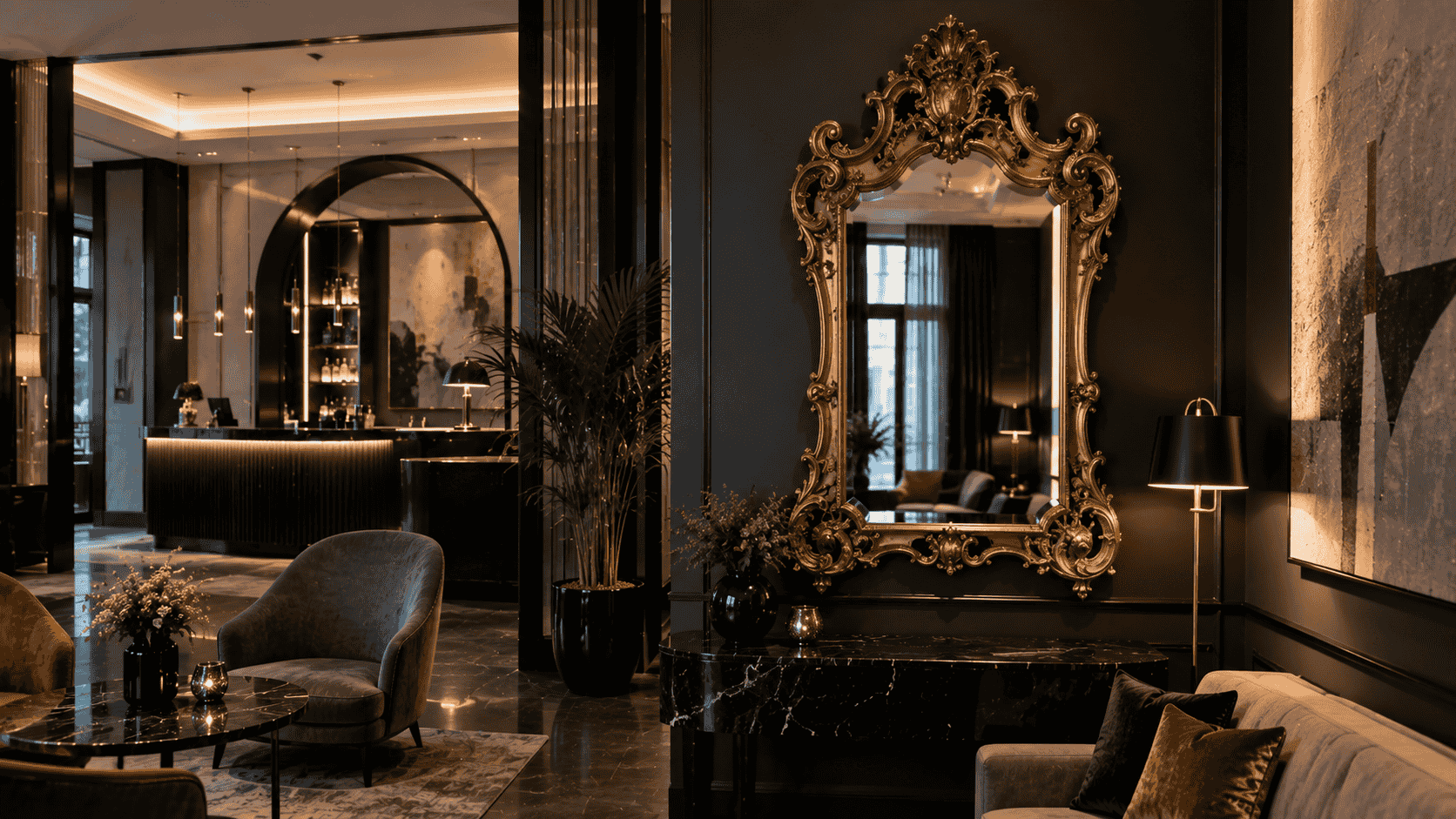
A 19th-century gilded frame against a matte charcoal wall. Ornate carvings reflecting minimalist pendant lights. The pairing sounds impossible. Yet across Europe’s most daring hotels, the baroque mirror has become the ultimate design weapon.
We spoke with four EU interior designers who specialise in this exact tension. Their consensus? The clash is the point.
Why Designers Are Reaching for the Baroque
Contemporary hotels risk sterility. Flat surfaces. Neutral tones. Functional furniture. Guests feel calm but forgettable. A gold baroque mirror injects the opposite. Drama. History. Handcrafted imperfection.
Milan-based designer Elena Rossi explains, “A baroque style mirror carries three centuries of visual weight. It commands attention. In a room of straight lines, that curved, gilded presence becomes the anchor.”
Properties from Copenhagen to Crete now place these mirrors in unexpected locations. Lobbies. Corridors. Even bathrooms. The result is not confusion. It is conversation.
The Three Rules of No-Clash Integration
Our experts shared non-negotiable strategies for mixing periods without visual war.
First, control the colour temperature. A gold baroque mirror demands warm ambient lighting. Cool LEDs create a jarring hospital effect. Stick to 2700K bulbs. The gold glows rather than screams.
Second, limit surrounding ornament. One baroque style mirror per space. Pair it with a concrete floor, a leather sofa, a steel side table. Do not add tassels, brocade, or additional gilding. The mirror alone carries the heritage weight.
Third, scale deliberately. Oversized Baroque hotel furniture pieces fail in tight contemporary rooms. Choose a baroque mirror that occupies 30 to 40 percent of the wall width. Anything larger overwhelms. Anything smaller reads as accidental.
Where to Position for Maximum Effect
Lisbon designer Miguel Santos transformed a stark white lobby using a single gold baroque mirror behind the reception desk. “Guests stop to photograph themselves in it,” he says. “The contrast between the ornate frame and the clean desk creates a natural social media moment.”
Another winning location: the headboard wall. Mount a baroque style mirror horizontally above a low, upholstered bed. The reflection doubles natural light. The carved detailing breaks the monotony of padded fabric.
For bathrooms, choose smaller baroque mirror formats. A gilded oval above a freestanding stone tub signals luxury without competing with fixtures. Keep the vanity itself minimalist.
Avoiding the Costume Trap
The greatest risk is themed decoration. A baroque mirror surrounded by candelabras, velvet drapes, and tasseled lamps reads as a period film set. That is not heritage integration. That is cosplay.
Modernist architect Le Corbusier famously placed a gold baroque mirror in his otherwise stark Villa La Roche. The secret? Nothing else in the room referenced the 18th century. The mirror stood alone as a sculptural object, not a historical reenactment.
Apply the same discipline. Your baroque style mirror is an artwork with function. Treat it as such. White walls. Concrete floors. Simple linens. Let the mirror perform.
Restoration Considerations for Hotel Use
Hotel mirrors endure different wear than residential pieces. Original baroque mirror mercury backing degrades over time. Guests expect clear reflection, not romantic distortion.
Designer Anna Weber from Vienna recommends professional resilvering for any antique baroque mirror destined for guest rooms. “Preserve the frame’s original patina,” she advises. “But replace the glass with modern, distortion-free silvering. Guests will never know. They will only appreciate how well they can see themselves.”
For high-touch areas like lobbies, consider a gold baroque mirror with a protective clear coat over the gilding. Fingers leave marks. Housekeeping wipes them. The finish must withstand daily cleaning without dulling.
Sourcing That Tells a Story
Hotels that succeed with this look do not buy reproductions. They source genuine period baroque style mirrors from EU auctions and estate sales. Each scratch, each slight warp in the glass, each softened gilded edge tells a truth.
One Amsterdam property labels each baroque mirror with its approximate origin date and previous home. Guests read the card. They connect with the object. That connection becomes a review mentioning “character” and “soul.”
Reproductions lack that depth. They look new. They feel manufactured. And in a heritage-versus-modern equation, a fake baroque mirror satisfies neither side.
Conclusion
The most memorable contemporary hotels do not erase history. They invite it into dialogue. A gold baroque mirror mounted on a brutalist concrete wall creates friction. That friction generates attention. Attention generates bookings.
Your space does not need to choose between centuries. Let the baroque style mirror prove that the past and present belong in the same room.
You may also read
Schreibe einen Kommentar