Many owners of European boutique hotels assume that baroque furniture belongs only in grand suites or spacious lobbies. The elaborate carving, deep seats and generous proportions of classic baroque sofas appear too dominant for smaller rooms. Yet the reality is more flexible. With careful selection of scale, a well-chosen piece can deliver the same sense of occasion without crowding the floor plan.
This guide examines whether a baroque sofa can work in a typical small boutique hotel suite. It focuses on realistic room sizes, usable clearances, and the practical difference between a full sofa and a compact settee. The goal is to give owners and designers a clear method for deciding what fits and what does not.
Understanding Typical Boutique Suite Dimensions
Boutique hotel suites in Europe often range from 25 to 40 square metres of net living space after accounting for the bathroom. Junior suites commonly fall between 29 and 38 square metres, while more compact city properties may offer only 22 to 28 square metres of usable floor area.
Within these footprints the bed usually claims the largest single zone. A standard European king or large queen mattress leaves limited remaining space for seating, circulation and service access. The remaining rectangle or L-shaped area must accommodate a desk or console, storage and at least one seating element that still feels intentional rather than squeezed.
Circulation is the critical factor. Guests and housekeeping staff need roughly 80 to 100 centimetres of clear path around the main furniture. Anything less quickly makes the room feel constrained.
Full Baroque Sofa Versus Compact Settee
A traditional three-seat baroque sofa typically measures 210 to 240 centimetres in width, 90 to 100 centimetres in depth and 90 to 110 centimetres in height, including the carved crest. In a generous suite these dimensions create a strong focal point. In a compact suite the same piece can block movement and leave too little space for a coffee table or secondary chair.
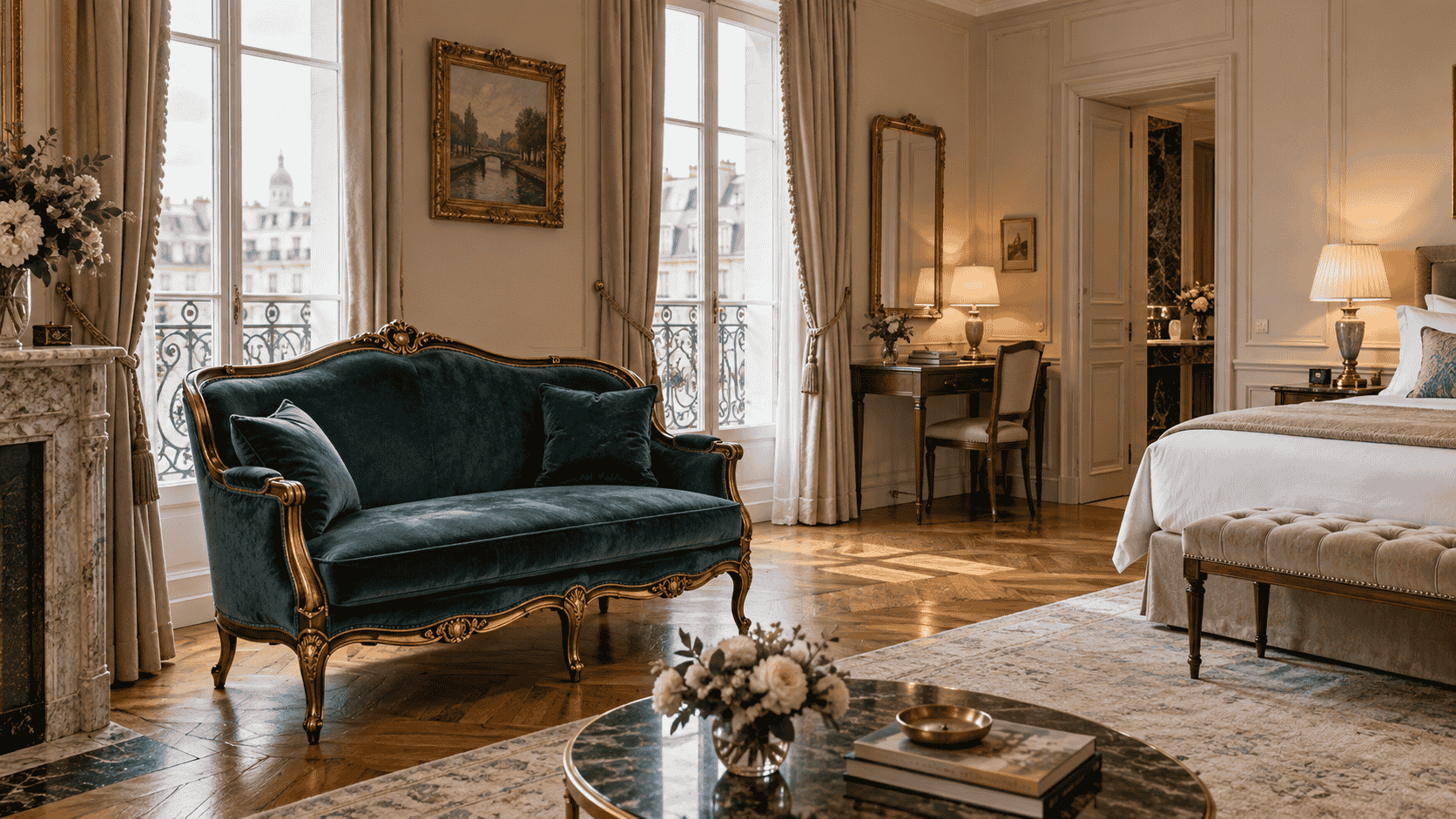
A compact baroque settee offers a more practical alternative. Many makers produce two-seat versions between 135 and 165 centimetres wide while retaining the characteristic curved arms, carved legs and tufted back. Depth usually stays around 75 to 90 centimetres. These proportions still communicate the language of baroque furniture yet occupy far less floor area.
The visual difference is noticeable. A full sofa announces scale and formality. A well-proportioned settee delivers the same ornamental richness at a scale that respects the room. Guests still experience the carved detail and rich upholstery without the sense that furniture dominates every view.
Calculating Usable Clearance
Successful placement depends on accurate measurement rather than visual estimation. Begin with a scaled floor plan of the suite. Mark the bed, wardrobe and desk positions first. Then test the proposed sofa or settee in the remaining zone.
Leave at least 90 centimetres between the front edge of the seating and any facing wall or furniture. Allow 60 to 80 centimetres on each side for access. If a small coffee table is included, maintain 40 to 50 centimetres between the seat edge and the table so guests can move freely.
In many 30-square-metre junior suites a compact settee of 150 centimetres width leaves sufficient clearance for both circulation and a modest side table. A full 230-centimetre sofa often forces the designer to eliminate the table or reduce path widths below comfortable levels. The settee therefore preserves both comfort and visual balance.
Practical Layout Strategies for Small Suites
Position the seating against the longest uninterrupted wall opposite or adjacent to the bed. This creates a distinct lounge zone without interrupting the main circulation path from the entrance to the bathroom. Avoid placing a large baroque sofa at the foot of the bed in tight rooms; the resulting corridor becomes too narrow for easy movement with luggage.
Choose lighter upholstery colours or restrained gilt finishes when the suite is particularly compact. Dark velvet and heavy gold leaf can make the piece appear larger. A softer palette keeps the eye moving and helps the room feel more open.
Lighting also influences perceived scale. A wall sconce or floor lamp placed beside a compact settee draws attention to the carving without requiring additional floor space. The result is a focused statement that still leaves room for guests to move comfortably.
When a Full Baroque Sofa Remains Viable
Not every boutique suite is small. Properties with 40 square metres or more of living space can often accommodate a full three-seat baroque sofa, especially when the suite includes a separate sitting area. In these cases the larger piece becomes an asset rather than a constraint. It anchors the lounge zone and reinforces the hotel’s commitment to distinctive baroque furniture.
The decision therefore depends on measured space rather than style preference alone. Owners who begin with accurate room data and clear circulation targets can confidently select either a full sofa or a compact settee according to the actual footprint.
Making the Choice with Confidence
A baroque sofa can work successfully in a small boutique hotel suite when the proportions match the available floor area. Compact settees that retain the essential carved character of baroque sofa sets offer the most reliable solution for rooms under 35 square metres. Full-sized pieces remain excellent choices where space allows.
The key is measurement, not compromise. Scaled plans, realistic clearances and a clear comparison between sofa and settee dimensions enable owners to introduce the richness of baroque furniture without sacrificing guest comfort or operational ease. When these factors align, even a modest suite can deliver a memorable and distinctive experience.
Frequently Asked Questions
What is the maximum recommended width for a baroque sofa in a 30-square-metre suite?
A compact settee between 140 and 160 centimetres wide usually leaves adequate circulation. Full sofas over 200 centimetres often reduce usable space below comfortable levels.
How much clearance should remain in front of the seating?
Aim for at least 90 centimetres between the front edge of the sofa or settee and any facing furniture or wall to allow easy movement.
Can a full three-seat baroque sofa ever fit a junior suite?
Yes, when the suite exceeds approximately 38 to 40 square metres and includes a distinct sitting zone separate from the bed area.
Do compact baroque settees still look authentic?
When the carving depth, arm profile and fabric quality match larger models, a well-made settee retains the essential character of classic baroque furniture at a more practical scale.
You may also read
Gold, White, Black or Silver? Choosing the Right Baroque Furniture Finish for Hotel Bedrooms
Where Should You Place a Baroque Sofa for Maximum Visual Impact?
Schreibe einen Kommentar