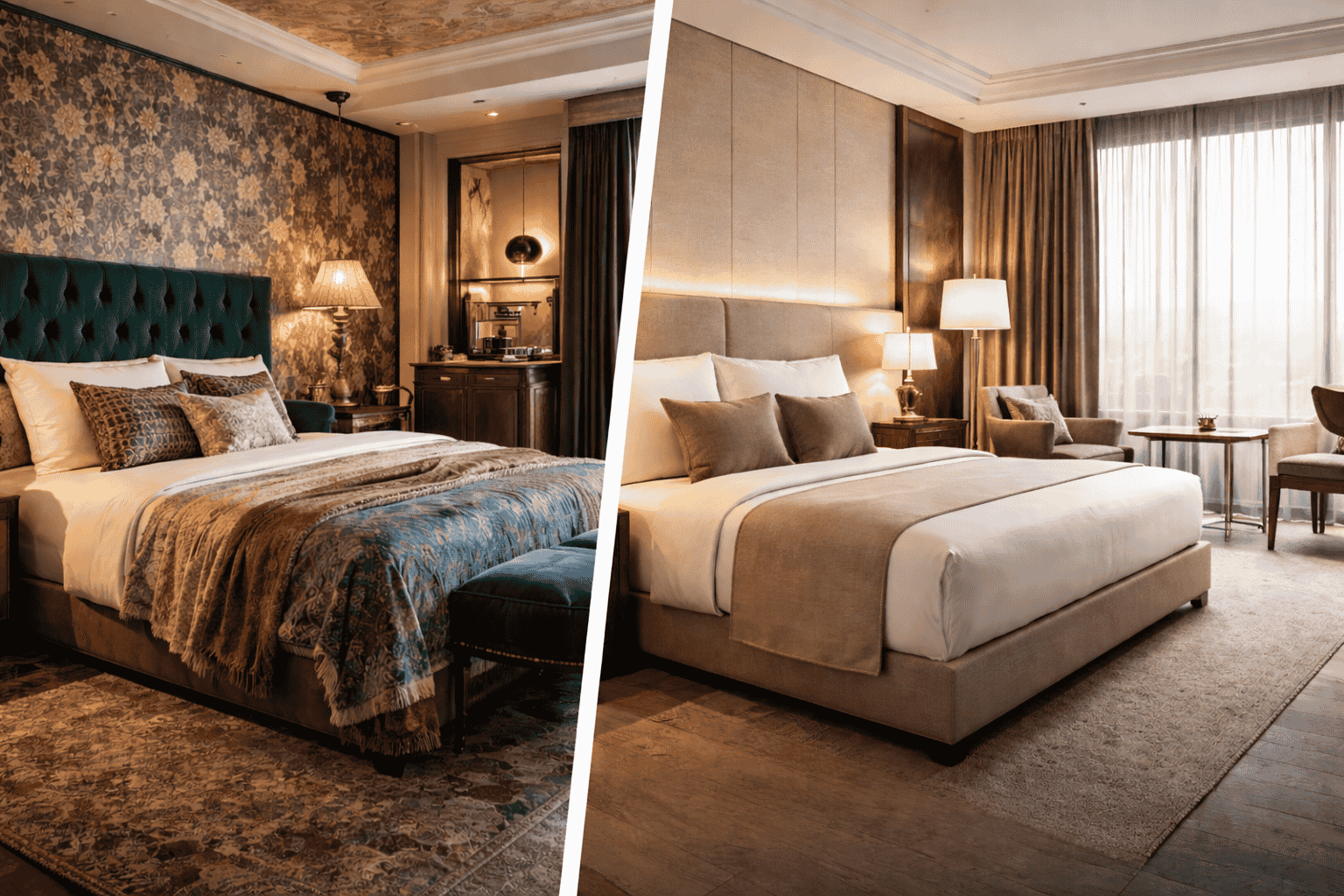
Hotel room furniture is no longer just a functional requirement—it is a strategic tool that shapes guest perception, brand identity, and long-term operational success. Across Europe’s hospitality landscape, boutique hotels and large luxury chains approach hotel room furniture very differently, driven by contrasting priorities around storytelling, scalability, and consistency.
For hotel developers, owners, and interior designers, understanding these differences is essential when investing in luxury hotel furniture that aligns with long-term positioning rather than short-term trends.
Why Hotel Room Furniture Decisions Matter More Than Ever
According to STR Global hospitality data, over 65% of guest satisfaction scores are influenced by room comfort and design, not service interactions alone. This places enormous importance on hotel room furniture—beds, wardrobes, desks, seating, and storage systems that guests interact with daily.
Whether a hotel is boutique or part of a global chain, furniture choices directly affect:
- brand recognition
- guest loyalty
- online reviews
- refurbishment cycles
- total cost of ownership
However, the approach to furniture investment varies dramatically between boutique hotels and large luxury chains.
Boutique Hotels: Furniture as Brand Storytelling
Boutique hotels rely heavily on emotional connection. Guests choose them for individuality, character, and authenticity. As a result, boutique hotel furniture is designed to reinforce narrative rather than standardisation.
Customization as a Priority
Boutique properties typically favour:
- bespoke bed frames and wardrobes
- custom finishes and materials
- locally inspired design elements
- limited repetition across rooms
This high level of customization allows boutique hotels to express personality through furniture. According to a 2024 Booking.com traveller survey, 74% of luxury travellers prefer unique hotel interiors over standardised luxury rooms—a statistic that strongly supports boutique design strategies.
Smaller Scale, Higher Design Freedom
With fewer rooms to furnish, boutique hotels can afford deeper customization without operational complexity. Furniture becomes part of the storytelling—each piece reinforcing the hotel’s concept.
The downside? Custom furniture often means:
- higher unit cost
- longer lead times
- more complex maintenance
Yet boutique hotels accept this trade-off because brand identity is their primary competitive advantage.
Large Luxury Chains: Furniture Built for Consistency
Large luxury chains operate across countries, cultures, and hundreds—or thousands—of rooms. Their priority is consistency, predictability, and operational efficiency.
Scalability Over Individual Expression
For global brands, branded hotel furniture must deliver:
- identical comfort across properties
- standardised dimensions and layouts
- predictable manufacturing timelines
- simplified replacement and maintenance
According to Deloitte Hospitality Insights, chain hotels reduce refurbishment costs by up to 30% through furniture standardisation. This explains why luxury chains invest heavily in repeatable furniture systems.
Brand Identity Through Repetition
Rather than uniqueness, chains build identity through familiarity. Guests recognise the brand instantly because room layouts, furniture proportions, and finishes feel consistent worldwide.
In this model, luxury hotel furniture becomes a reliability tool rather than a storytelling device.
Customization vs Scalability: The Core Difference
The fundamental contrast lies in customization vs scalability.
| Aspect | Boutique Hotels | Large Luxury Chains |
| Design approach | Bespoke, expressive | Standardised, repeatable |
| Furniture sourcing | Custom manufacturers | Approved global suppliers |
| Brand expression | Unique per property | Consistent across locations |
| Cost strategy | Higher unit cost | Lower cost at scale |
| Refurbishment | Less frequent but deeper | Regular and systematic |
Neither approach is superior—each supports a different business model.
Material Choices and Durability Expectations
Both hotel types demand durability, but their thresholds differ.
- Boutique hotels prioritise tactile richness—solid wood, stone, textured fabrics
- Luxury chains prioritise performance materials—engineered cores, replaceable components, tested upholstery
According to EU hospitality procurement benchmarks, furniture replacement cycles average 7–10 years for boutique hotels and 5–7 years for large chains, reflecting different durability strategies.
Well-designed hotel room furniture must balance aesthetics with wear resistance regardless of model.
Operational Impact of Furniture Choices
Furniture affects daily operations more than most owners realise.
Boutique Hotels
- Higher maintenance complexity
- Specialist repair requirements
- Greater visual payoff
Luxury Chains
- Faster room turnaround
- Easier inventory management
- Simplified staff training
This operational difference directly influences profitability, especially in high-occupancy urban markets.
Guest Expectations: Experience vs Familiarity
Guest psychology differs sharply between the two segments.
- Boutique guests seek surprise, character, and emotional connection
- Chain guests seek reliability, comfort, and predictability
A 2023 Skift Research study showed that repeat bookings are 22% higher in luxury chains, while social sharing and review engagement are higher in boutique hotels.
Furniture choices support these behavioural patterns.
Hybrid Luxury: Where the Market Is Moving
An emerging trend blends both worlds. Many modern luxury hotels now adopt:
- standardised furniture platforms
- custom finishes and detailing
- modular designs with visual variation
This hybrid approach allows scalability while preserving brand individuality—a strategy increasingly favoured by upscale European hotel groups.
Choosing the Right Furniture Strategy
When selecting hotel room furniture, owners should ask:
- Is brand identity or operational scale the priority?
- How often will rooms be refurbished?
- Who is the primary guest demographic?
- What is the long-term maintenance plan?
Furniture decisions made today shape brand perception for the next decade.
Conclusion: Furniture as a Strategic Asset
Hotel room furniture is not just a design decision—it is a business strategy. Boutique hotels use furniture to express individuality and emotional depth, while large luxury chains use it to deliver consistency and trust.
Understanding the balance between customization vs scalability, brand identity, and operational efficiency allows hotel owners to invest wisely in luxury hotel furniture that supports both guest satisfaction and long-term profitability.
In a competitive European hospitality market, furniture is no longer silent—it speaks the language of the brand.
Schreibe einen Kommentar