
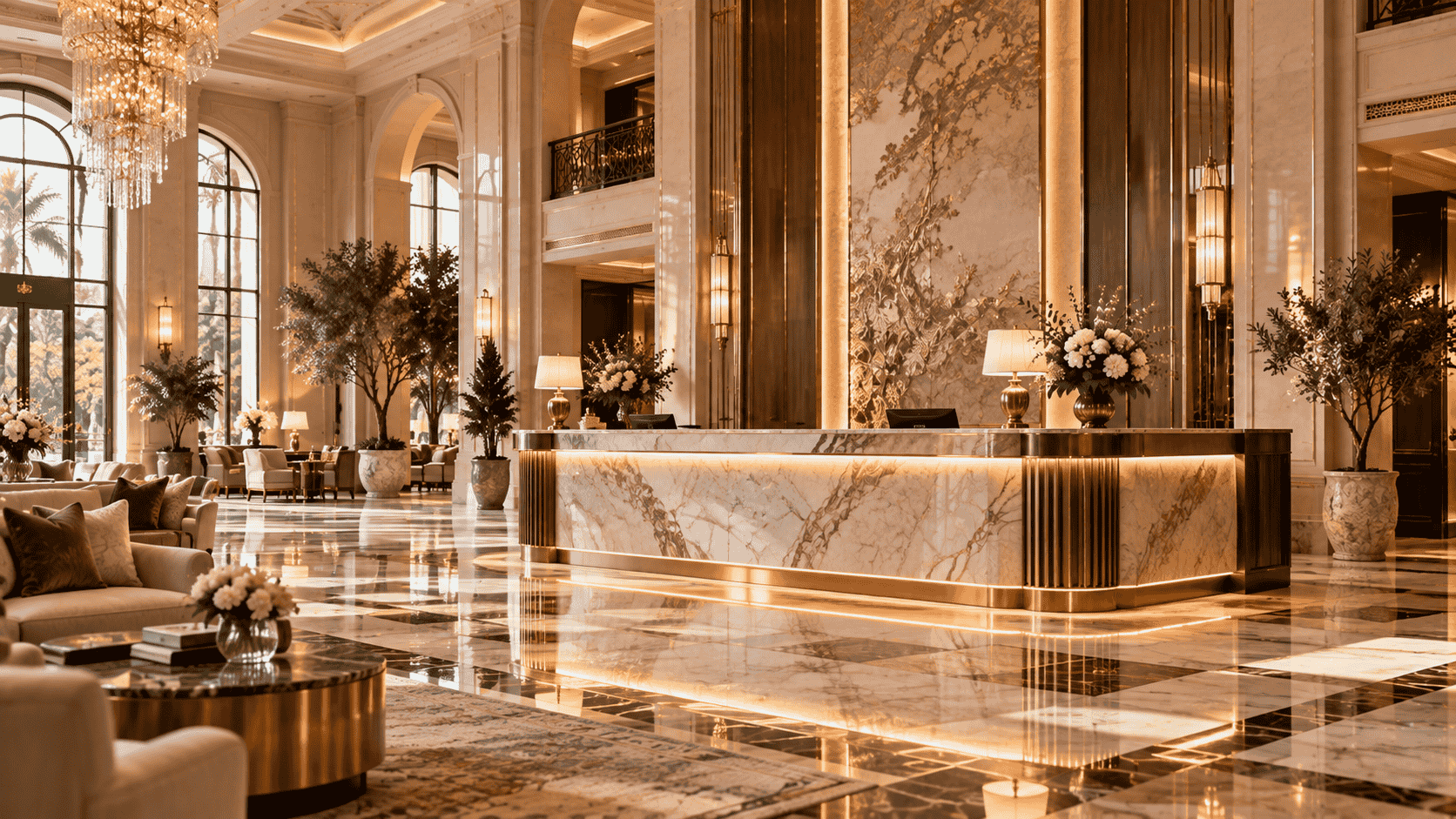
Guests decide how they feel about a hotel long before they speak to a staff member. Research into environmental perception shows that people form strong assessments of a space in a matter of seconds. In hospitality that window is especially short. By the time a guest has walked from the entrance to the reception area—roughly twelve seconds in a typical lobby—the core judgment is already in place.
That judgment is not based on a single detail. It is the rapid accumulation of visual and sensory cues centred on the luxury hotel reception desk and the zone immediately around it. The desk is the physical and symbolic destination of arrival. Everything the guest sees, feels and senses in those first moments either reinforces or undermines the promise of the stay.
Understanding and controlling those cues is one of the highest-leverage design decisions a hotel can make.
The Twelve-Second Window Explained
The first few seconds are devoted to orientation. The guest’s eyes search for a clear destination. A well-placed hotel lobby reception desk that is visible from the entrance reduces uncertainty and signals order. If the desk is hidden, poorly lit or visually cluttered, the brain registers mild stress before any interaction begins.
Within the same brief interval the guest evaluates material quality, lighting temperature, spatial calm and human presence. These impressions are formed largely below conscious awareness, yet they colour every subsequent evaluation of service, cleanliness and value.
The reception desk sits at the centre of this process because it is the one object the guest is actively moving toward. Its design, condition and context become the primary evidence of the hotel’s standards.
Visual Cues That Shape Instant Judgment
Clarity of path is the first visual requirement. Guests should be able to identify the reception zone within the first three to four seconds. Strong sight lines, consistent flooring transitions and controlled lighting that draws the eye toward the desk all support this recognition.
Material quality is read almost as quickly. Stone, solid timber, refined metal or high-quality veneer communicate permanence and care. Surfaces that appear thin, scratched or improvised send the opposite message. In luxury settings the luxury hotel reception desk is expected to feel substantial. Lightweight or temporary-looking constructions undermine that expectation even if the rest of the lobby is carefully finished.
Proportion and presence matter equally. A desk that is too small for the volume of the lobby feels apologetic. One that is correctly scaled relative to the space and the surrounding luxury hotel furniture feels intentional and confident. Guests register this balance without analysing it.
Order is non-negotiable. Visible clutter—loose papers, tangled cables, personal items—creates an immediate impression of operational looseness. A clean, composed desk surface signals that the hotel is in control of details.
Sensory Layers Beyond the Visual
Light quality influences mood within seconds. Warm, layered lighting around the reception zone feels welcoming. Harsh overhead light or uneven shadows create a sense of institutional efficiency rather than hospitality. The desk itself benefits from focused illumination that makes staff faces and the transaction surface clear without glare.
Scent operates even faster. A consistent, carefully chosen ambient fragrance can lower stress responses and create a sense of place before the guest has fully oriented. When the scent is absent or unpleasant, the negative effect is equally rapid.
Sound contributes as well. A lobby that feels acoustically harsh or chaotic raises tension. Soft background levels and the absence of sharp, disruptive noises support the calm the visual design is trying to establish.
Together these sensory layers either support or contradict the visual message of the hotel lobby reception desk.
Human Presence in the Critical Window
Design sets the stage; people complete the impression. Guests notice whether staff are aware of their arrival. Eye contact, a nod or a brief acknowledgment within the first moments signals that the hotel is attentive. The absence of recognition, even for a few extra seconds, registers as indifference.
The physical design of the desk can help or hinder this human moment. Lower or more open profiles allow staff to step forward and greet guests more naturally. High, solid barriers can create a sense of separation that feels formal rather than welcoming.
How Design Decisions Control the Twelve Seconds
Controlling the first impression begins with the desk as the anchor of the arrival sequence. It should be visible from the entrance, correctly scaled to the lobby, and finished in materials that match the intended brand position.
Surrounding luxury hotel furniture and architectural elements should support rather than compete with the desk. Clear circulation paths, consistent material language and controlled lighting all reinforce the same message of order and quality.
Maintenance is part of design. A beautifully specified desk that is allowed to accumulate dust, fingerprints or visual clutter loses its power within days. Daily standards for the reception zone are as important as the original specification.
The Cost of Getting It Wrong
When the twelve-second window goes poorly, recovery is difficult. Guests who form a negative first impression tend to interpret later interactions through that filter. Minor delays feel longer. Small imperfections feel more significant. Positive service has to work harder to overcome the initial judgment.
Conversely, a strong first impression creates a halo. Guests arrive predisposed to interpret the rest of the stay favourably. The investment in a well-resolved luxury hotel reception desk and its immediate context therefore pays returns far beyond the check-in transaction itself.
A Practical Focus for Owners and Designers
The most effective approach is to treat the reception zone as a complete sensory environment rather than a piece of furniture alone. Map the guest’s path from entrance to desk. Test sight lines, lighting and material quality under real arrival conditions. Ensure that staff can deliver recognition within the critical window. Protect the composition through consistent operational standards.
When these elements are aligned, the first twelve seconds work in the hotel’s favour. Guests feel oriented, reassured and quietly impressed before a single word of welcome is spoken. That early emotional advantage is one of the most reliable foundations a luxury property can build.
Frequently Asked Questions
Is twelve seconds a fixed scientific measure?
It is a practical approximation based on environmental psychology research showing that strong spatial impressions form in a handful of seconds. Exact timing varies with lobby size and layout, but the principle remains consistent.
Can a beautiful desk overcome a confusing entrance path?
Only partially. If guests cannot quickly locate the desk, the initial stress of disorientation still colours the experience. Path clarity and desk presence must work together.
How important is scent compared with visual design?
Scent operates rapidly and emotionally. A well-chosen ambient fragrance supports the visual message; an absent or unpleasant one can undermine even strong design.
Should the reception desk always be the most prominent object in the lobby?
It should be the clearest destination for arriving guests. Other strong design features can exist, but they should not compete with the desk for the primary arrival sight line.
You may also read
Schreibe einen Kommentar