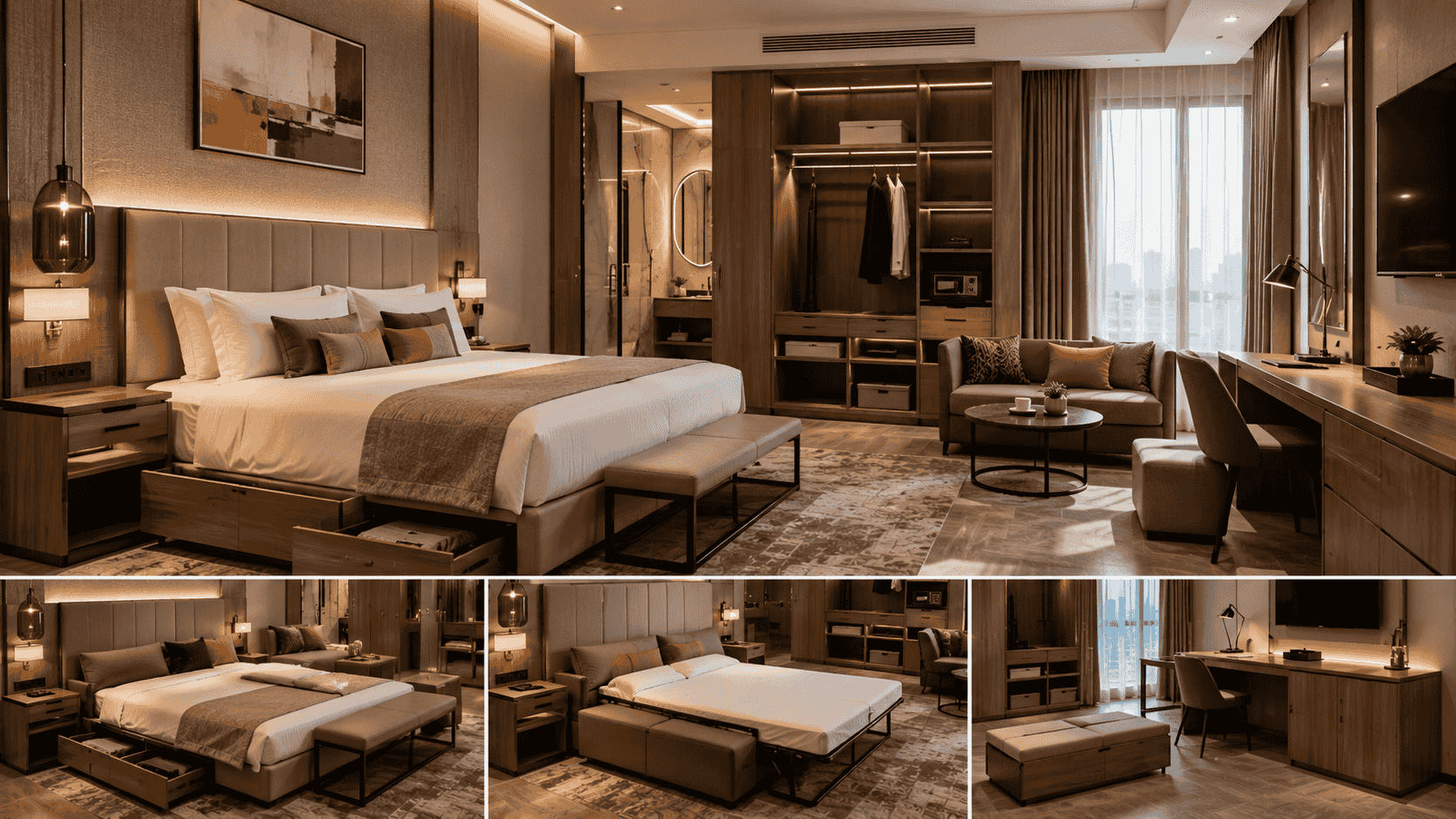
The hotel guest of 2026 is not the same traveler from five years ago. Work schedules blur with leisure. Families request adjoining configurations one night, and solo business travelers need a focused workspace the next. Fixed, heavy bedroom sets cannot keep pace. That is why forward‑thinking properties are switching to modular hotel furniture—a system that bends without breaking.
Imagine a hotel bedroom set that transforms from a king‑size retreat into two twin rooms within an hour. Or a wardrobe that doubles as a luggage bench. Or a desk that folds into a vanity. This is not speculative fiction. This is the new standard for flexible hotel suite furniture that delivers higher occupancy and happier guests.
The Changing Anatomy of a Hotel Stay
Walk through a boutique hotel lobby built in 2018. The bedrooms are uniform. Every room has the same nightstands, the same dresser, the same static layout. Fast forward to today. That rigidity frustrates modern travelers. A digital nomad needs a proper desk and accessible power outlets. A young family needs floor space for a crib and open storage for toys. A couple celebrating an anniversary wants a minibar that hides away.
Hotel bedroom furniture that cannot adapt leaves money on the table. Properties with modular hotel furniture report up to 22% higher average nightly rates, because guests willingly pay for rooms that feel customized to their needs.
One independent hotelier in Austin, Texas, recently shared a before‑and‑after story. Her twelve rooms originally had identical hotel bedroom set layouts. Occupancy hovered at 68%. After installing modular systems—moveable room dividers, wheeled nightstands, and stackable storage cubes—occupancy jumped to 84% within six months. Guest reviews specifically praised the “room that changed with us.”
Multi‑Use Pieces: The Heart of Modular Design
What makes flexible hotel suite furniture truly flexible? Pieces that serve more than one purpose. Consider a bedside table on locking casters. It holds a lamp and a phone charger by night. By day, it rolls against the wall to become an extra seat or a laptop stand. A single unit performs three jobs.
Another essential is the convertible wardrobe. Half of its interior holds hanging garments. The other half contains removable shelves and a pull‑out writing surface. Close the doors, and the guest sees a clean, elegant façade. Open them, and the room gains a private desk. This dual function eliminates the need for a separate work station, freeing valuable floor space.
Modular headboards also deserve attention. A padded panel that spans the bed’s width can integrate reading lights, USB ports, and small storage cubbies. When two rooms combine for a family suite, the headboard easily detaches and reattaches to the new bed configuration. No tools. No maintenance calls. Just seamless adaptation.
For hotel operators, the ROI calculation is straightforward. Modular hotel furniture reduces the need for multiple room types. Instead of building separate “family,” “business,” and “accessible” rooms, you design one modular shell that shifts between those categories on demand. Inventory becomes dynamic. Revenue per square foot rises.
Before and After: A Conversion Hotel Case Study
Picture a tired 1980s motor lodge undergoing a boutique conversion. Original room size averages 240 square feet—tight by modern standards. The old hotel bedroom set consisted of a bulky dresser, a desk that blocked the window, and two nightstands that never aligned with the bed after moves.
The renovation team replaced everything with a modular system. A wall‑hung floating console runs the length of the bed. It includes two flip‑down desks and three open cubbies. Guests can raise one desk for work and keep the other folded for storage. The dresser was eliminated entirely. Instead, an under‑window bench contains four deep drawers and a lift‑up top for luggage.
The result? The same 240 square feet now feels like 300. Guest satisfaction scores for room layout jumped from 3.2 to 4.7 out of 5. Housekeeping reported 30% less time moving furniture to clean floors. The hotel recouped its furniture investment in fourteen months through higher rates and repeat bookings.
This transformation relied entirely on hotel furniture designed for adaptability. No custom millwork. No permanent fixtures. Every piece can be repositioned or removed within minutes.
Layout Diagrams That Work
Effective modular hotel furniture follows three spatial principles. First, keep the bed within 18 inches of an electrical outlet on both sides. Second, position the modular wardrobe/desk unit opposite the bed, so the work surface does not face a blank wall. Third, leave a clear 30‑inch pathway from door to window, even when all modules are fully extended.
A simple diagram (imagine a rectangle with the bed centered on one long wall, the convertible wardrobe on the opposite wall, and a mobile nightstand on each side of the bed) shows how air flows and guests move. No dead corners. No awkward reaches for light switches. This is the blueprint of future‑proofed hospitality.
The Operational Payoff
Beyond guest satisfaction, flexible hotel suite furniture slashes back‑of‑house costs. When a group books ten rooms for a conference, the hotel can configure each room with a desk and ergonomic chair. When a wedding party arrives the next weekend, those same rooms convert to lounge‑style layouts with soft seating and cocktail tables. One furniture inventory serves multiple purposes.
Replacing damaged pieces becomes simpler too. Instead of hunting for a discontinued dresser, you swap in a modular component from the same product family. Consistency stays intact. Maintenance shrinks.
Hotel operators who ignore modularity are building anchor rooms that soon sink. The guest does not want to adapt to the room. The room must adapt to the guest. Modular hotel furniture delivers that promise without expensive renovations every five years.
Final Assembly
The era of the identical, immovable hotel bedroom set is closing. Today’s guest expects a chameleon space that mirrors their shifting needs. Hotel furniture that rolls, folds, stacks, and transforms is no longer a luxury. It is a competitive necessity.
For boutique owners planning a conversion or a refresh, start with a modular core. Choose pieces that earn their square footage twice over. Watch your reviews turn from “the room was fine” to “the room amazed me.” That is the sound of flexibility paying off.
Schreibe einen Kommentar